The general form of a quadratic function is
The graph of a quadratic function is a parabola , a type of -dimensional curve.
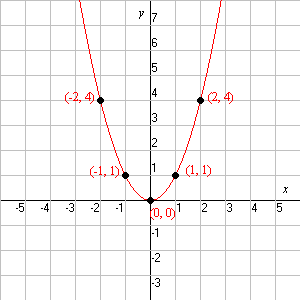
The "basic" parabola, looks like this:
The function of the coefficient in the general equation is to make the parabola "wider" or "skinnier", or to turn it upside down (if negative)
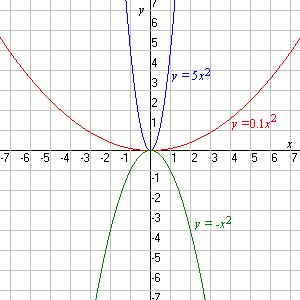
f the coefficient of is positive, the parabola opens up; otherwise it opens down.
The Vertex
The vertex of a parabola is the point at the bottom of the " " shape (or the top, if the parabola opens downward).
The equation for a parabola can also be written in "vertex form":
In this equation, the vertex of the parabola is the point
The coefficient of here is . This means that in the standard form, , the expression
gives the -coordinate of the vertex.
Example:
Find the vertex of the parabola.
Here, and . So, the -coordinate of the vertex is:
Substituting in the original equation to get the -coordinate, we get:
So the vertex of parabola is (-2,-24)
